#1134: SCORSESE, Martin: Raging Bull (1980)
SCORSESE, Martin (United States)
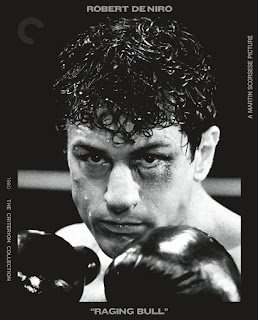
Raging Bull [1980]


Director/Writer


Video essays
By film critics Geoffrey O’Brien and Sheila O’Malley.
Trailer
Raging Bull [1980]
Spine #1134
Blu-ray

With this stunningly visceral portrait of self-destructive machismo, Martin Scorsese created one of the truly great and visionary works of modern cinema. Robert De Niro pours his blood, sweat, and brute physicality into the Oscar-winning role of Jake La Motta, the rising middleweight boxer from the Bronx whose furious ambition propels him to success within the ring but whose unbridled paranoia and jealousy tatter his relationships with everyone in his orbit, including his brother and manager (Joe Pesci) and gorgeous, streetwise wife (Cathy Moriarty). Thelma Schoonmaker’s Oscar-winning editing, Michael Chapman’s extraordinarily tactile black-and-white cinematography, and Frank Warner’s ingenious sound design combine to make Raging Bull a uniquely powerful exploration of violence on multiple levels—physical, emotional, psychic, and spiritual.
129 minutes
Black and White
Black and White
2.0 Surround
1:85:1 aspect ratio
1:85:1 aspect ratio
Criterion Release 2022


Martin Scorsese was 38 when he directed Raging Bull.
Screenplay by Paul Schrader and Mardik Martin.
#1318: Alice Doesn't Live Here Anymore (1974)
#1118: The Last Waltz (1978)
#1185: After Hours (1985)
#70: The Last Temptation of Christ (1988)
#913: The Age of Innocence (1993)
#1058: The Irishman (2019)
#1062: Rolling Thunder Revue: A Bob Dylan Story by Martin Scorsese (2019)
#1118: The Last Waltz (1978)
#1185: After Hours (1985)
#70: The Last Temptation of Christ (1988)
#913: The Age of Innocence (1993)
#1058: The Irishman (2019)
#1062: Rolling Thunder Revue: A Bob Dylan Story by Martin Scorsese (2019)
The Film


Do you suppose Scorsese might have had this in mind?

After the critical failure of New York, New York (1977), Scorsese's drug addiction nearly killed him. Robert De Niro (Jake La Motta) saved his life, visiting him in the hospital and convincing him to make this film.
"Successful individuals may self-destructively sabotage their own achievements; this may stem from a feeling of anxiety, unworthiness, or from an impulsive desire to repeat the 'climb to the top.'"
Perhaps Scorsese's own situation helped him relate to La Motta's story. In any case, he apparently believed that this would be his last film. He put his heart and soul into making it a great film, even though he initially had no interest in either the subject of boxing, in general, or La Motta's life story, in particular.
**
The story unfolds beautifully in crisp, stark black and white.
A nearly unrecognizable De Niro (the production was halted for four months while the actor put on 60 pounds to play the older La Motta) is preparing to go on stage at the Barbizon in 1964. The scene is completed at the end of the film.
From that point on, the biography toggles between the fights (staged with boxer/actors in terrifying close-ups, with sound design [Frank Warner] that uses unique combined sounds for each punch) and fictionalized incidents from his life.
1941 vs. Jimmy Reeves
1944 vs. Sugar Ray Robinson (1st fight)
1947 vs. Robinson (2nd fight)
1949 vs. Tony Janiro
1949 vs. Billy Fox
1950 vs. Marcel Cerdan
1951 vs. Robinson (3rd fight)
The casting (Cis Corman) is brilliant. In his first major role, Joe Pesci (Joey La Motta) is smooth and natural as Jake's brother/manager. He and De Niro trade verbal spars as neatly as the physical ones (watch for the oof as De Niro hits him a little too hard, for real!)
The violence outside the ring is perhaps the most disturbing, and tends to paint the leading man in a most unsavory light. A fight with Vickie (a young Cathy Moriarty) leads directly to an even more ferocious fight scene with Joey.
The brutal fight with Salvy (Frank Vincent) is perhaps the most gut-wrenching scene in the film. Look for a spot-on performance as a Mafia don (Tommy Como) by Nicholas Colasanto (Cheers).
The Extras
The Booklet
Forty-eight page booklet featuring essays by poet Robin Robertson and film critic Glenn Kenny.
Commentaries
The Booklet
Forty-eight page booklet featuring essays by poet Robin Robertson and film critic Glenn Kenny.
Commentaries
1. Featuring Scorsese and editor Thelma Schoonmaker
Scorsese:
"If you ask people who were with him at the time — his wife Vickie, or Pete Savage — it becomes a 'Rashomon' situation; everyone has their own version of what the truth is."
Schoonmaker:
"The use of slow motion in this film is quite extraordinary. Marty always took three speeds of slow motion for each shot that he knew he was possibly going to use ... 48 frames per second, 90 or 120 ... one of those speeds would be ideal for the moment it was needed."
1:26:00: Scorsese references a debt to Hitchcock here, timing his cuts to match the shower scene in Psycho (1960).
2. DP Michael Chapman, producers Robert Chartoff and Irwin Winkler, casting director Cis Corman, music consultant Robbie Robertson, and others
Chapman brings an intelligent understanding to the DP work. Robertson's contribution is enlightening, especially about the diligent recording of the background music, with The Band.
3. Boxer La Motta and screenwriter Martin and Schrader.
La Motta is urged on by his nephew, Jason Lustig. At least he doesn't try to sugarcoat the mess that his life became.
By film critics Geoffrey O’Brien and Sheila O’Malley.
Fight Night
A making-of program featuring Scorsese and key members of the cast and crew.
Three short programs
Highlighting the collaboration between Scorsese and actor De Niro.
Television interview
From 1981 with actor Moriarty and the real Vikki La Motta.
Interview
With La Motta from 1990.
Program
From 2004 featuring veteran boxers reminiscing about La Motta.
A making-of program featuring Scorsese and key members of the cast and crew.
Three short programs
Highlighting the collaboration between Scorsese and actor De Niro.
Television interview
From 1981 with actor Moriarty and the real Vikki La Motta.
Interview
With La Motta from 1990.
Program
From 2004 featuring veteran boxers reminiscing about La Motta.

Comments
Post a Comment