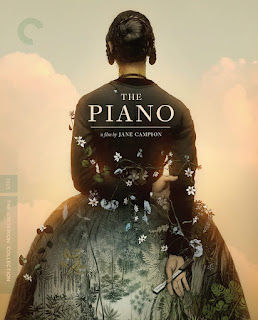
#1110: CAMPION, Jane: The Piano (1993)
CAMPION, Jane (New Zealand, Australia, France)
The Piano [1993]


Commentary
Featuring Campion and producer Jan Chapman.
Conversation
Between Campion and film critic Amy Taubin.
Interview 1
With actor Hunter on working with Campion.
“The Piano” at 25
A program featuring a conversation between Campion and Chapman.
Interview 2
With composer Michael Nyman.
A featurette including interviews actors Hunter, Keitel, and Neill.
By Campion: The Water Diary.
The Piano [1993]
Spine #1110
Blu-ray

With this sublimely stirring fable of desire and creativity, Jane Campion became the first woman to win a Palme d’Or at Cannes. Holly Hunter is achingly eloquent through silence in her Academy Award–winning performance as Ada, an electively mute Scottish woman who expresses her innermost feelings through her beloved piano. When an arranged marriage brings Ada and her spirited daughter (Anna Paquin, in her Oscar-winning debut) to the wilderness of nineteenth-century New Zealand, she finds herself locked in a battle of wills with both her ineffectual husband (Sam Neill) and a rugged frontiersman (Harvey Keitel) to whom she develops a forbidden attraction. With its sensuously moody cinematography, dramatic coastal landscapes, and sweeping score, this uniquely timeless evocation of a woman’s inner awakening is an intoxicating sensory experience that burns with the twin fires of music and erotic passion.
121 minutes
Color
Color
5.1 Surround
in English and Maori
1:85:1 aspect ratio
in English and Maori
1:85:1 aspect ratio
Criterion Release 2022


Director/Writer
Jane Campion who was 39 when she wrote and directed The Piano.
Other Campion films in the Collection:
The Film


A magnificent film!
Campion's camera dances, swoops, glides, and inspects — never calling attention to itself. Perhaps only Malick can equal her ability to incorporate landscape as a filmic character.
Her storytelling is concise and unpretentious. Big chunks of plot are elided, which, on reflection, seem to be good cinematic choices ...
Ada McGrath (Holly Hunter) is mute (although she narrates) and speaks through her piano — a Broadwood (Beethoven's favorite). Hunter actually plays the music herself; Michael Nyman's score is magical.
The love triangle is composed of her new husband (an arranged marriage) —Alisdair Stewart (Sam Neill) — and a lover who trades sex for the piano, George Baines (an excellent Harvey Keitel).
A young Anna Paquin (Flora McGrath) rounds out the cast, also populated by native Maoris, elegantly portrayed as naive, inquisitive and sublime.
Camption depicts Ada's ultimate fate as a bifurcated choice between life and death — leaving the viewer to interpret the moment.
A magnificent film!
The Extras
The Booklet
Twelve-page wraparound featuring an essay by critic Carmen Gray.
The Booklet
Twelve-page wraparound featuring an essay by critic Carmen Gray.
"A landslide hit the grounds of Seacliff Lunatic Asylum, the largest building in nineteenth-century New Zealand, just a few years after its opening in 1884. Such unruly movements of the earth are frequent in that part of the world, where active plate tectonics, steep country, and heavy rainfall frightened the scores of colonial settlers arriving around that time with a sense that they might be washed into the sea at any moment. Indeed, the asylum — with its imposing scale and turreted, Gothic Revival structure — seems to have been designed with this possibility in mind. Though the mental hospital had closed by the time I attended university in nearby Dunedin in the 1990s, its ruins remained, gripping us with a morbid teenage fascination, not least because visionary novelist Janet Frame had been confined there intermittently from 1945 with a schizophrenia misdiagnosis, mocked by nurses as 'Miss Educated,' subjected to electric shock treatment, and only narrowly avoiding a scheduled lobotomy when she was awarded a literary prize. We'd all read her at school, and she had lit up the sky with her expansive imagination outside dreary provincialism — even as her lost years were a drastic reminder of the high stakes for freethinking women in a society fearful that unconventionality paved the way to insanity."
Commentary
Featuring Campion and producer Jan Chapman.
"She (Ada) was unheard and would be unheard and that there was no point in speaking because her world was not interested in hearing what women really think or feel."
Somewhat surprising to hear how she studied Fellini to understand shot design.
Conversation
Between Campion and film critic Amy Taubin.
Influence of Wuthering Heights.
Interviews
With DP Stuart Dryburgh, production designer Andrew McAlpine, and Maori adviser Waihoroi Shortland.
Interviews
With DP Stuart Dryburgh, production designer Andrew McAlpine, and Maori adviser Waihoroi Shortland.
Dryburgh:
"It is better to be lucky than good, but when you get lucky, you'd better be good at it."
Interview 1
With actor Hunter on working with Campion.
“The Piano” at 25
A program featuring a conversation between Campion and Chapman.
Interview 2
With composer Michael Nyman.
Inside “The Piano”
A featurette including interviews actors Hunter, Keitel, and Neill.
2006 short film
By Campion: The Water Diary.
Trailer

Comments
Post a Comment